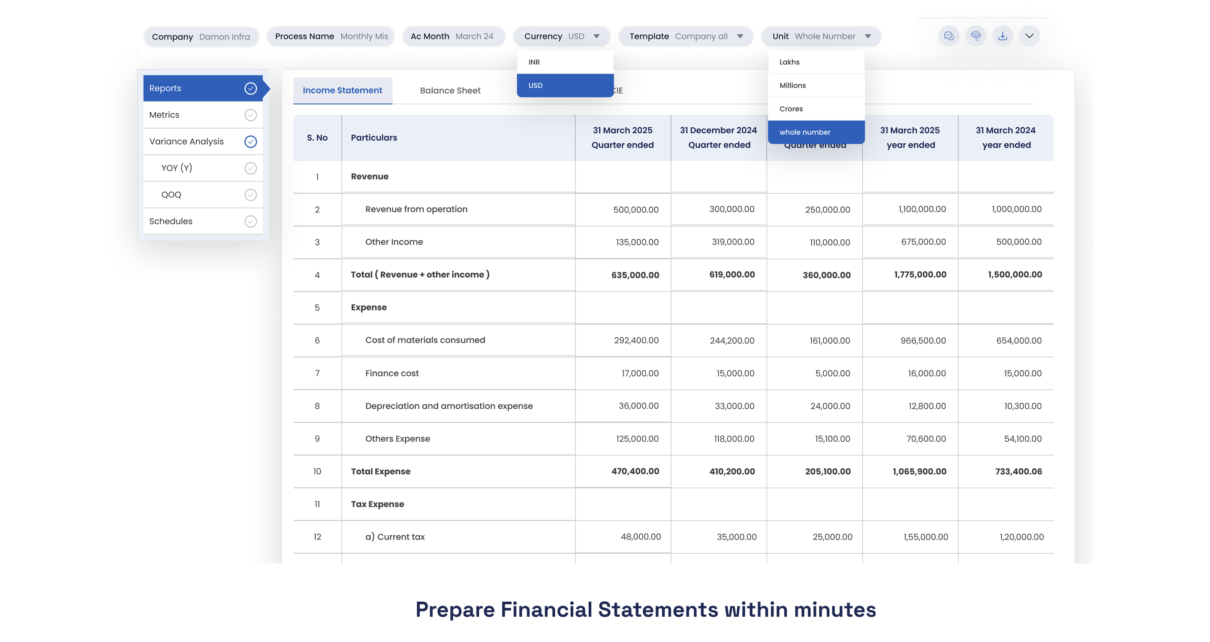
In today’s complex business environment, organizations must manage financial data across multiple subsidiaries, currencies, and systems while maintaining strict compliance with global accounting standards. Manual processes and spreadsheet-based reporting often lead to delays, errors, and limited financial visibility. This is why modern enterprises are increasingly adopting Financial Consolidation Software to transform how they manage financial reporting. Platforms such as Result Lane provide automated consolidation, real-time reporting, and advanced analytics that enable finance teams to produce accurate, compliant, and timely financial reports. By centralizing financial data and automating key processes, financial consolidation solutions help organizations improve reporting efficiency and gain deeper insights into their financial performance.
Understanding Financial Reporting Challenges
Financial reporting is a critical function within any organization. It involves compiling financial data, analyzing performance, and producing standardized reports such as balance sheets, income statements, and cash flow statements.
For companies with multiple entities, financial reporting becomes significantly more complex. Finance teams must gather financial data from different departments, subsidiaries, and regions, often using different accounting systems.
Common challenges include:
- Fragmented financial data across systems
- Manual data entry and spreadsheet dependency
- Time-consuming reconciliation processes
- Currency conversion complexities
- Intercompany transaction adjustments
- Compliance with multiple accounting standards
These challenges not only slow down financial reporting cycles but also increase the risk of inaccuracies.
Financial consolidation software addresses these issues by automating data integration and reporting workflows.
What Is Financial Consolidation Software?
Financial consolidation software is a specialized platform designed to combine financial data from multiple business entities into a unified financial view. It automates complex processes such as data aggregation, intercompany eliminations, currency conversion, and financial statement generation.
Instead of relying on spreadsheets and manual processes, finance teams can use consolidation software to streamline reporting workflows and improve financial transparency.
Modern platforms like Result Lane provide additional capabilities such as real-time dashboards, predictive analytics, and integrated financial planning tools, allowing organizations to move beyond traditional reporting toward strategic financial management.
Key Ways Financial Consolidation Software Improves Financial Reporting
Financial consolidation software enhances financial reporting in several critical ways.
1. Centralized Financial Data Management
One of the most significant improvements provided by consolidation software is centralized data management.
Organizations often use multiple accounting systems across subsidiaries, making it difficult to create a unified financial view.
Financial consolidation software integrates with these systems and consolidates financial data into a single platform. This ensures that all financial information is stored in a centralized repository.
Benefits include:
- A single source of truth for financial reporting
- Improved data consistency across departments
- Easier access to financial information
Centralized data management also reduces the risk of discrepancies between different financial reports.
- Automated Data Aggregation
Manual data collection is one of the most time-consuming aspects of financial reporting.
Consolidation software automates the process of importing financial data from ERP systems, accounting tools, and databases. This eliminates the need for manual data entry and reduces the risk of human error.
Automated data aggregation enables finance teams to compile financial reports more quickly while ensuring data accuracy.
- Streamlined Intercompany Eliminations
Organizations with multiple subsidiaries frequently conduct transactions between entities. These intercompany transactions must be eliminated during consolidation to avoid double counting.
Manually identifying and reconciling these transactions can be complex and time-consuming.
Financial consolidation software automatically detects intercompany transactions and performs elimination entries during the consolidation process.
This ensures that financial reports accurately reflect the organization’s financial position.
- Accurate Multi-Currency Reporting
Global companies often operate in multiple currencies, which adds complexity to financial reporting.
Financial consolidation software automatically converts financial data into a common reporting currency using predefined exchange rates.
This allows organizations to:
- Generate accurate global financial reports
- Maintain consistency in currency translation
- Comply with international accounting standards
Automated currency conversion also reduces the risk of reporting errors.
- Faster Financial Close Cycles
Financial close processes often take significant time when performed manually. Finance teams must collect data, validate information, reconcile accounts, and prepare reports.
Financial consolidation software accelerates this process through automation.
Key improvements include:
- Automated reconciliation workflows
- Real-time data validation
- Faster report generation
Organizations that implement consolidation software often reduce their financial close cycle from several weeks to just a few days.
- Improved Financial Accuracy
Errors in financial reporting can have serious consequences, including regulatory penalties and loss of stakeholder trust.
Spreadsheet-based processes are especially vulnerable to errors such as broken formulas, incorrect data entries, and version control issues.
Financial consolidation software improves accuracy through:
- Automated calculations
- Built-in validation rules
- Standardized reporting templates
These features help ensure that financial statements are reliable and consistent.
- Real-Time Financial Insights
Traditional financial reporting often relies on historical data that may already be outdated by the time reports are generated.
Modern consolidation platforms provide real-time reporting dashboards that allow finance leaders to monitor financial performance continuously.
These dashboards offer insights into key metrics such as:
- Revenue growth
- Profit margins
- Operational costs
- Cash flow performance
Real-time insights enable executives to make faster and more informed decisions.
- Enhanced Regulatory Compliance
Organizations must comply with various financial reporting standards and regulations.
Financial consolidation software helps ensure compliance by standardizing reporting processes and maintaining detailed audit trails.
Key compliance features include:
- Automated reporting aligned with IFRS and GAAP
- Complete audit trails for financial adjustments
- Role-based access controls for financial data
These capabilities simplify audits and improve regulatory transparency.
Strategic Benefits Beyond Reporting
While financial consolidation software primarily improves reporting efficiency, it also provides broader strategic benefits.
Better Financial Planning
With centralized financial data and real-time analytics, organizations can create more accurate financial forecasts and budgets.
Improved Decision-Making
Executives gain a comprehensive view of financial performance across all business units, enabling data-driven decision-making.
Greater Operational Efficiency
Automation reduces the workload on finance teams, allowing them to focus on higher-value activities such as financial analysis and strategic planning.
Result Lane’s Approach to Financial Consolidation
Result Lane offers an advanced financial consolidation platform designed to help organizations modernize financial reporting and performance management.
Key capabilities include:
Automated Consolidation Processes
Result Lane automates complex tasks such as intercompany eliminations, currency conversions, and data aggregation.
Seamless System Integration
The platform integrates with existing ERP and financial systems, enabling efficient data collection and synchronization.
Real-Time Financial Analytics
Interactive dashboards and analytics tools provide instant visibility into financial performance.
Scalable Architecture
Result Lane’s platform supports organizations with complex multi-entity structures and global operations, making it suitable for rapidly growing enterprises.
By combining automation, cloud technology, and advanced analytics, Result Lane enables finance teams to transform their reporting processes.
The Future of Financial Reporting
Financial reporting is evolving rapidly as organizations adopt automation and artificial intelligence.
Future trends in financial consolidation and reporting include:
- Continuous financial close processes
- AI-powered financial forecasting
- Predictive financial analytics
- Real-time enterprise-wide financial visibility
These innovations will allow finance teams to transition from reactive reporting to proactive financial strategy.
Conclusion
Financial consolidation software plays a vital role in improving financial reporting by automating complex processes, centralizing financial data, and providing real-time insights into organizational performance.
By eliminating manual workflows and reducing reporting errors, consolidation platforms enable finance teams to generate accurate financial statements faster and more efficiently.
Solutions like Result Lane are helping organizations modernize financial reporting through automation, integrated analytics, and scalable financial management tools. As businesses continue to grow and operate in increasingly complex environments, financial consolidation software will remain essential for achieving transparency, accuracy, and strategic financial oversight.